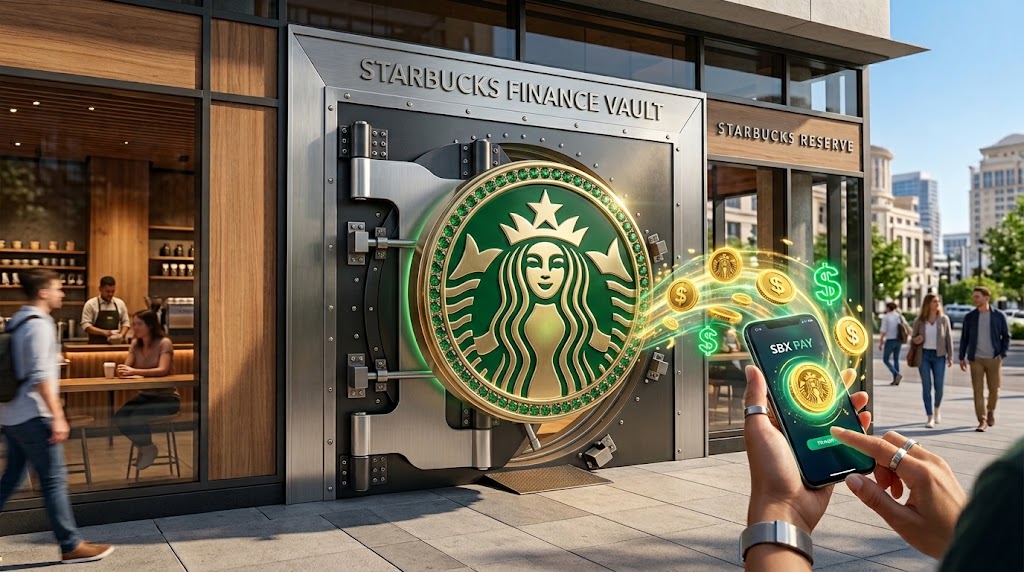
Starbucks' $222 Million "Ghost Money"
How an unregulated bank built a 100% profit margin - and the blueprint to fund your own machine
The Unregulated Bank On Every Corner
You probably think Starbucks is a coffee company. It isn't. Behind the green aprons and overpriced seasonal lattes, Starbucks actually operates as a highly sophisticated non-bank financial institution. If you want proof, just look at their balance sheet from fiscal year 2025. They were holding a massive $1.84 billion liability in what they call "stored value".
What's stored value? It's the cash sitting on gift cards and pre-loaded into the mobile app. When a customer deposits fifty bucks to earn a few digital stars, they aren't just buying future coffee. They're handing a multinational conglomerate an unsecured, 0% interest loan. (I don't even drink the stuff, but I watch people wait in the drive-thru every morning thinking they're beating the system with free rewards - completely missing the fact that they're actively funding a corporate empire for free).

The scale of this operation is wild. Right now, 35.5 million active users treat the Starbucks app like a primary digital wallet. Those loyalists drive over $13 billion in annual spend and generate roughly 60% of all company-operated revenue in the U.S. The consumer trades cold hard cash for zero interest and a digital pat on the head - and the corporation takes that cash to build out its global footprint. They aren't just making drinks, ok? They're leveraging the public's money to win. It's time to wake up, stop giving your capital away and see the game for exactly what it is.
Dodging Wall Street and Cheating Visa
If a normal corporation needs to raise almost two billion dollars to fund its operations, they have to go beg Wall Street. Let's do the brutal math on that. If Starbucks went out and raised that $1.84 billion in the traditional corporate bond market at a standard 5.5% interest rate, it would cost them roughly $101.2 million in pure interest expense every single year. That's a massive hit to the bottom line.
Instead, they just let millions of people willingly load up the mobile app. By using those retail deposits instead of traditional debt, they manufacture over $100 million in shadow yield annually. They get all the growth capital they need and the customer happily pays the inflation tax.
Think about how a real bank works. A commercial bank has to pay you a yield to hold your money and when you want it back, they have to hand you actual cash. Starbucks pays 0% interest. Instead of paying you a yield, they toss out digital "Stars" that cost them absolutely nothing to mint. And the absolute best part is, when it's time to finally settle that massive $1.84 billion debt, they don't give you your cash back. They hand over a physical cup of coffee that costs them pennies to produce. It's the ultimate settlement cheat code.
But it gets even better. Every time you swipe a debit or credit card at a local business, the big networks like Visa and Mastercard take a massive cut. It's usually a percentage plus a heavy fixed swipe fee. If a customer buys a five-dollar coffee ten times a week, those fixed fees stack up and completely murder the profit margins. Starbucks solved this by building a closed-loop system.
By forcing people to preload their funds in $50 batches, Starbucks only pays that credit card interchange fee once. Then you make your ten individual purchases strictly inside their own ecosystem. This one hack completely bypasses the Visa and Mastercard cartel and saves the company tens of millions of dollars annually. I love watching massive corporations legally dodge credit card fees while the rest of us get nickel and dimed to death. You really have to respect the hustle.

This isn't just a clever loyalty program. This is the exact same wealth-building strategy Warren Buffett uses to run Berkshire Hathaway. Buffett built his entire empire on "insurance float" - collecting cash premiums upfront, investing them for massive returns and paying out claims way down the road. Starbucks is just doing the retail version of it. They get the cash today and hand you a drink next month. It's a top-tier billionaire strategy hiding right in plain sight. If you want to actually build wealth, you have to stop playing the consumer's game and start engineering your own float. Own your structure, protect your margins and act like the house.
The Breakage Glitch: $222 Million in Ghost Money
The absolute best part of this whole setup is the ghost money. In the finance world, they call it "breakage". It's just the cash sitting on lost gift cards and abandoned digital accounts. Think about it. The customer pays upfront, but Starbucks never has to grind a single bean, pour a drink or pay a barista. Because no product or labor is ever delivered, that cash drops straight to the bottom line at a 100% profit margin.
This isn't just pocket change, ok? In fiscal 2025 alone, Starbucks legally recognized a staggering $222.4 million in pure breakage revenue. It's the ultimate free money glitch.

Of course, that kind of cash grabs attention. Labor unions are actively throwing a fit over it. They claim Starbucks uses this massive flood of ghost money to quietly absorb hundreds of millions in operational costs and anti-union legal fees without shareholders even noticing. And iff you're going to fight expensive corporate battles, it definitely helps when the public accidentally pays your legal bills for you.
You might be wondering why the government doesn't step in and take that abandoned cash. States have "escheatment" laws designed to claim forgotten property. But Starbucks built a brilliant legal moat. Because their retail gift cards don't have expiration dates or dormancy fees, the funds technically never expire. That shields the money from state treasuries - and allows the corporation to legally sweep it right into their own profit columns.
The game is rigged to reward the house. If you want to win, you have to stop leaving your money on the table for someone else to sweep up. Take accountability for your capital and start building a system that pays you instead.
Engineering Your Own 0% Float
There's a massive mental gap between an employee and an owner. The standard consumer operates completely backward. You voluntarily loan your money to a giant conglomerate for zero percent interest while you eat all the inflation risk. The real equity-holding owner does the exact opposite. They aggressively acquire 0% loans to buy assets that spit out cash and generate a real return on investment. If the big guys refuse to use their own cash to grow, why are you draining your personal savings to fund your business? You need leverage. You need a system that brings capital in the door before you actually do the hard work. It's the only way to scale without burning yourself out.
You can build the exact same setup right now. For a small business, the direct equivalent of the app float is credit card stacking. Instead of begging a traditional bank for a slow loan, you strategically sequence the acquisition of three to five distinct credit cards. But you don't just grab any random card off the internet. You target high-tier accounts specifically offering a 0% introductory rate.
If you do it right, you aggregate a massive revolving credit facility of $50,000 to $150,000. You hold that money at absolutely 0% interest for 12 to 15 months. You use it to buy inventory, run marketing campaigns or scale operations. The profit stays in your pocket and the interest costs you absolutely nothing. You're playing the game with other people's money.

But you can't just log online and randomly hit apply. The banks run on a strict algorithmic rulebook. First, you need a pristine personal credit score of 680 or higher to act as your anchor. If your personal file is a mess, the institutional vault stays locked. Next, you have to carefully sequence your applications to beat the automated underwriting rules. Lenders like Chase have strict policies that will auto-deny you if you open too many accounts too fast.
You also have to hit different credit bureaus at the exact right times to avoid triggering bust-out fraud alerts. (I've seen too many smart business owners completely destroy their credit in a single afternoon because they thought they could outsmart a billion-dollar banking algorithm). The sequence matters just as much as the score.
Once you secure the initial capital, you start playing the long game. Over time, you shift the debt away from your personal guarantees. You establish a commercial credit profile linked directly to your Employer Identification Number. A mature EIN profile allows you to eventually secure massive non-recourse term loans without ever risking your own personal assets. You borrow their money, you build your business - and your family's house stays safely off the line. This is how real players scale. They protect their downside while using outside capital to multiply their upside.

Navigating this maze is exactly why 7 Figures Funding exists. We analyze your unique credit architecture and structure the application sequences for you and/or your clients. We know exactly how to maximize your limits across over 100 different lenders without detonating your personal credit file. You don't have to guess which banks to hit or what order to apply in. We handle the friction so you can focus on actually running the business.
You deserve to win, but nobody is going to hand you a blank check just because you have a good work ethic, ok? Take radical accountability for your cash flow, stop using your own money to grow - and build a machine that works for you instead of against you
Radical Accountability & The Sweat Equity Play
Look… as mentioned, I don't even drink the stuff, but I get why people want a morning caffeine hit. The problem isn't the coffee. The problem is participating blindly in someone else's wealth machine while your own business starves for capital. Staying broke while funding a corporate expansion is a choice. You need to take radical accountability for your earning structure right now.
Stop playing the role of the depositor handing out free loans and start acting like the bank. I spent way too long building other people's dreams before I realized I was the only one holding my own business back - you have to flip the script! If you're ready to secure real capital and build your own float, go check out the free Funding Machine case study right now. The blueprint is sitting right in front of you. You just have to plug in, take ownership and get to work.