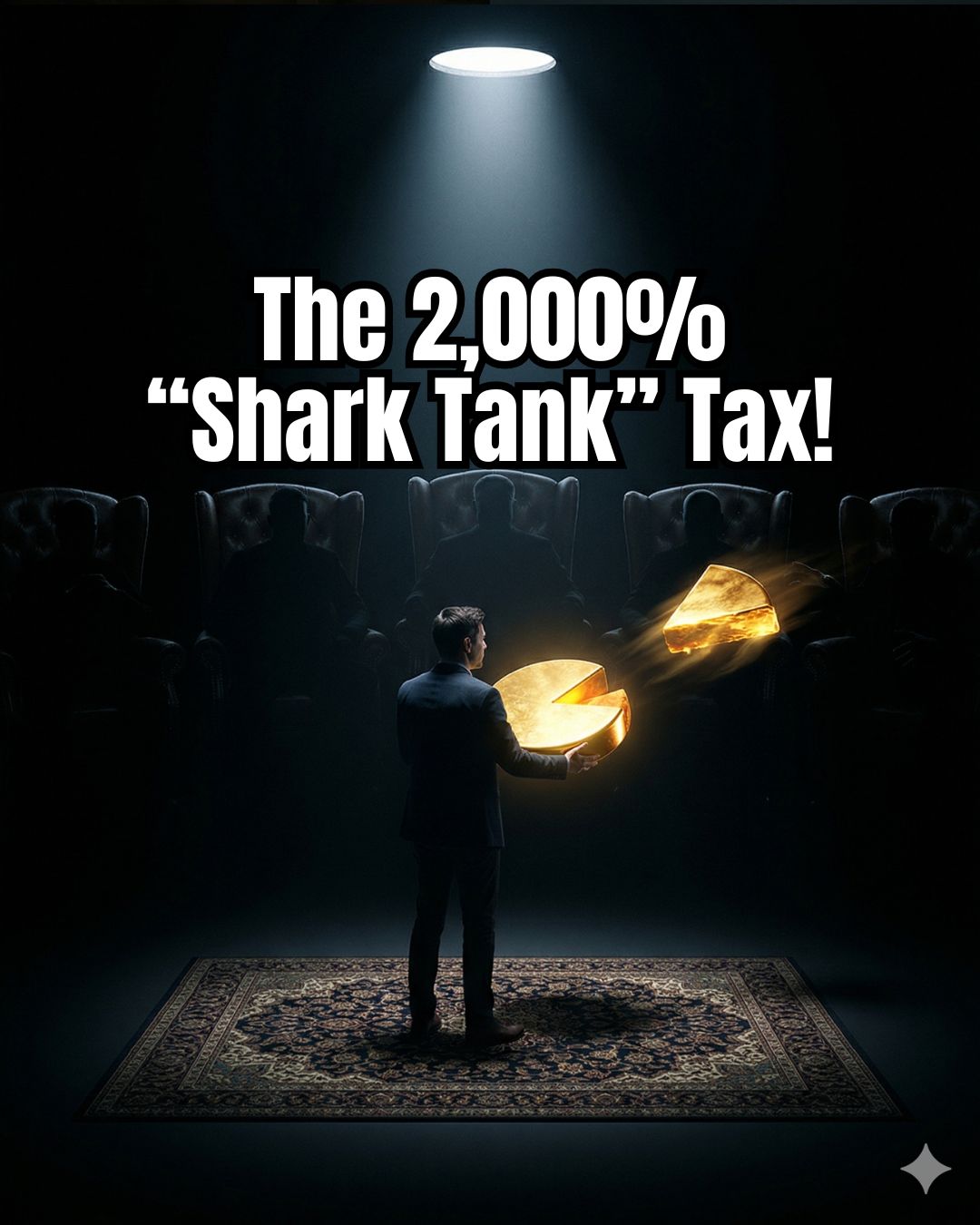
The 2,000% "Shark Tank" Tax
Why Founders Keep Falling for the Equity Lie
Picture this: You're standing on a rug, sweating under harsh studio lights. You're staring down a panel of celebrity billionaires, and if we're being honest, you're begging.
You're asking for a $100,000 check. In exchange, you are willingly offering to hand over 20% of the company you bled to build.
The dramatic music swells. The camera zooms in on your nervous face. A Shark leans forward and makes an offer. Tears of relief are shed, hands are shaken, and the deal is done.
We've been completely brainwashed by the media to think this is the absolute pinnacle of entrepreneurial success. It makes for fantastic, emotionally charged reality television. But if you take a step back and look at it mathematically? That founder just got completely fleeced in front of millions of people, and the audience cheered while it happened.
Here is the harsh, unspoken truth of the venture capital world: VCs and "Sharks" aren't buying your product. They are buying your fear - and they are buying it at a massive, predatory discount.
They know that you are terrified of leveraging debt. They know you are financially exhausted. So, they swoop in, offer you a relatively tiny injection of cash, and take a permanent, irreversible seat at your table.
If you don't believe me, let's look at the actual financial bloodbaths.
Take Bombas, the socially conscious sock company. Founders David Heath and Randy Goldberg went on national television and took $200,000 in exchange for a 17.5% stake from Daymond John. On the surface, it sounds like a massive, life-changing win. They got the Shark!
But let's run the math today. Bombas is currently valued at an estimated $3.42 billion. That means Daymond's slice of the pie is theoretically worth nearly $600 million. Think about that for a second. Those founders essentially paid $600 million for a $200,000 loan. That translates to an effective interest rate of roughly 300,000% for a tiny injection of early cash. Ouch.
Or look at Scrub Daddy. Aaron Krause had a brilliant product, but he gave up a massive 20% of his baby to Lori Greiner for just $200,000. At a $500 million valuation today, her stake is sitting pretty at around $100 million. Krause paid an effective interest rate of 49,900% just to get her on board.
Now, look at the alternative. Look at what happens when a founder actually understands leverage.
Jamie Siminoff walked into that exact same tank with a company called DoorBot (which you now know as Ring). Kevin O'Leary tried to trap him with a classic predatory deal: a royalty structure combined with an equity stake. Jamie did the unthinkable. He looked the billionaire in the eye, said no, and walked away with absolutely nothing.
The media called him crazy. But because he refused to pay the "Shark Tax," he retained his equity, bootstrapped his way to leverage, and eventually sold his company to Amazon in 2018 for a staggering $1 Billion.
He didn't sell his future out of fear. And neither should you.
The Heartfelt Challenge (The Empathy & The Mirror)
I get it. Building an empire from the middle class is absolutely terrifying.
There is no safety net beneath you. There is no massive trust fund waiting for you if things go sideways. Most days, it's just you, a glowing laptop screen at 2 AM, and the quiet, heavy fear of failing your family.
When you are carrying that kind of weight on your shoulders, it makes total sense why you'd want a billionaire "rich uncle" to swoop in, hand you a check, and absorb all the risk.
But here is the harsh truth.
You claim to believe in this idea. You sacrifice your weekends for it. You miss family dinners, you skip vacations, and you miss your kids' soccer games to keep it alive. You tell everyone who will listen that this business is going to completely change your family's trajectory.
So if you believe in your idea that much... why are you so terrified to put the bank's money where your mouth is?
Giving away early equity isn't a "strategic partnership."
It's a lack of conviction.
The Middle-Class Brainwashing (Why We Fear the Wrong Things)
If you are terrified of using the bank's money to grow your business, take a deep breath. It is not your fault. You are just running the exact financial script you were handed.
From the time we are in grade school, the middle class is taught a very specific set of rules: Save your pennies, avoid debt like the plague, and pay cash for absolutely everything. That is fantastic advice if your life goal is to be a quiet, safe, compliant employee. But it is absolute poison for a founder.
If you want to see exactly how deep this societal conditioning goes, look at the ultimate hypocrisy of the American financial system.
As a society, we will eagerly encourage an 18-year-old kid to sign paperwork for $100,000 in non-dischargeable student loan debt just to study 14th-century literature. We won't blink an eye when a guy finances a depreciating exotic car at 9% interest just to look rich at stoplights. And you probably wouldn't hesitate to walk into a bank tomorrow and sign a 30-year mortgage, taking on $500,000 in institutional debt for a house that produces absolutely zero cash flow. Between the property taxes, the mortgage interest, and the leaky roof, a house literally only takes money out of your pocket.
But the second someone suggests leveraging $50,000 in 0% business credit to fund an income-producing asset that could actually change your family tree forever?
You freeze in absolute terror.
Why does this happen? Society has a massive blind spot. We have been trained to comfortably accept wealth-extracting Consumer Debt (like swiping a card at 24% interest for a flat-screen TV), but we are terrified of self-liquidating Producer Debt (like borrowing at 0% to hire a killer sales team). We gladly borrow money to buy the things that keep us trapped in the rat race, but we freeze up when it's time to borrow money for the exact things that could set us free.
The Brutal Math (The Relatable "Fear Tax")
Let's forget about the billion-dollar unicorns and reality TV stars for a second. Let's look at your actual reality. Let's run the math on a normal, highly successful founder's exit, and look at what happens when the bill comes due.
Scenario A: The Equity Trap You need $100,000 to scale your marketing and hire a team. You panic, play it "safe," and give away 20% of your company to an angel investor. You put your head down, grind through five brutal years of sleepless nights, and build a beautiful, highly profitable $10 Million business. Then, you decide to sell.
You sit at the closing table, and the wire hits. But wait - that 20% you gave away years ago? It is now worth $2 Million.
That means your original $100k "investment" just cost you $1.9 Million directly out of your own pocket. Because you were terrified of utilizing a basic loan, you effectively took on a financial partner with a 1,900% interest rate. You did 100% of the work, and they walked away with a massive chunk of your generational wealth.
Scenario B: The OPM Cheat Code Now, let's replay the tape the way the wealthy play the game. You need $100,000. Instead of begging an investor, you use the backdoor strategy. You stack $100,000 in 0% interest business credit.
You put your head down, grind for five years, and build the exact same $10 Million company. You exit.
You hand the bank back their $100,000 principal. Because you operated within the promotional windows, you pay $0 in interest.
You walk away with $9.9 Million.
You just preserved $1.9 Million in your own personal wealth. Not by working harder. Not by building a better product. Not by being smarter than your competition. You preserved your wealth simply by using debt to fund the finish line instead of selling your equity for parts.
The Pivot (The Bank is Your Best Investor & The Mechanics)
It is time to stop begging for permission to build your dream.
If you look behind the curtain, the true titans of industry do not trade their equity for early cash flow. They don't sell their future just to keep the lights on today. They use leverage. They use Other People's Money (OPM).
And instead of fighting for one massive, traditional loan from a mega-bank - a loan that usually requires a mountain of paperwork, three years of tax returns, and a blood sacrifice just to get a "no" - the pros use a backdoor.
We call it the 0% Stacking Play.
Instead of asking for one huge check, you secure multiple smaller, promotional lines of credit and stack them together to build a massive war chest of capital. We are talking about exact market tools sitting right out in the open: the Chase Ink Business Cash, the American Express Blue Business Plus, and the Wells Fargo Signify Business Cash.
Why is this infinitely better than a Shark?
Because the bank doesn't want a seat on your board. They don't want to micromanage your marketing, they don't want to steal your operational control, and they absolutely do not want a piece of your company. They just want their fixed return.
Even better, these are business lines of credit. That means they carry a massive hidden benefit: they don't report to your personal credit profile. You can max out a $30,000 business card to fund a marketing campaign, and your personal credit score won't drop a single point. You are completely shielding your personal life from your business risk.
For these unsecured business lines, the banks don't even need physical collateral. The underwriting algorithm doesn't care about your "passion," your "vision," or how good your pitch deck looks. It is completely emotionless, and it only cares about three specific numbers:
- A personal FICO score over 700 (sometimes 680).
- Revolving credit utilization under 30% (45% at the absolute maximum).
- A flawless payment history with no recent derogatory marks.
Give the algorithm exactly what it wants, and the vault opens.
But what happens when that 12 to 18-month 0% honeymoon phase ends?
You still don't go crawling to a VC. You graduate. You walk right into a local community bank or credit union - the boring, reliable institutions sitting right down the street in your own hometown - and you get a standard commercial term loan at 8% to 10%.
Paying a prime interest rate to a boring local bank is infinitely cheaper than handing over a fifth of your empire's future valuation to an investor.
And we at 7 Figures Funding can also help you rework those 0% credit lines to maximize your results in the process!
Keep your equity. Use their money.
Fund the Finish Line
Your business is your baby. It is your ultimate ticket out of the middle class, and it is the key to changing your family's financial destiny forever.
Stop selling it for parts just to keep the lights on.
We built the Funding Machine to help founders exactly like you unlock 0% 3rd-party capital so you can keep 100% of your empire. The capital is sitting right there in the vault, waiting for founders who have the guts to use it.
It is time to finally bet on yourself. Stop giving away your future, and start using Other People's Money.
Click below to watch the free case study and see exactly how to secure your capital today.
Link to Case Study