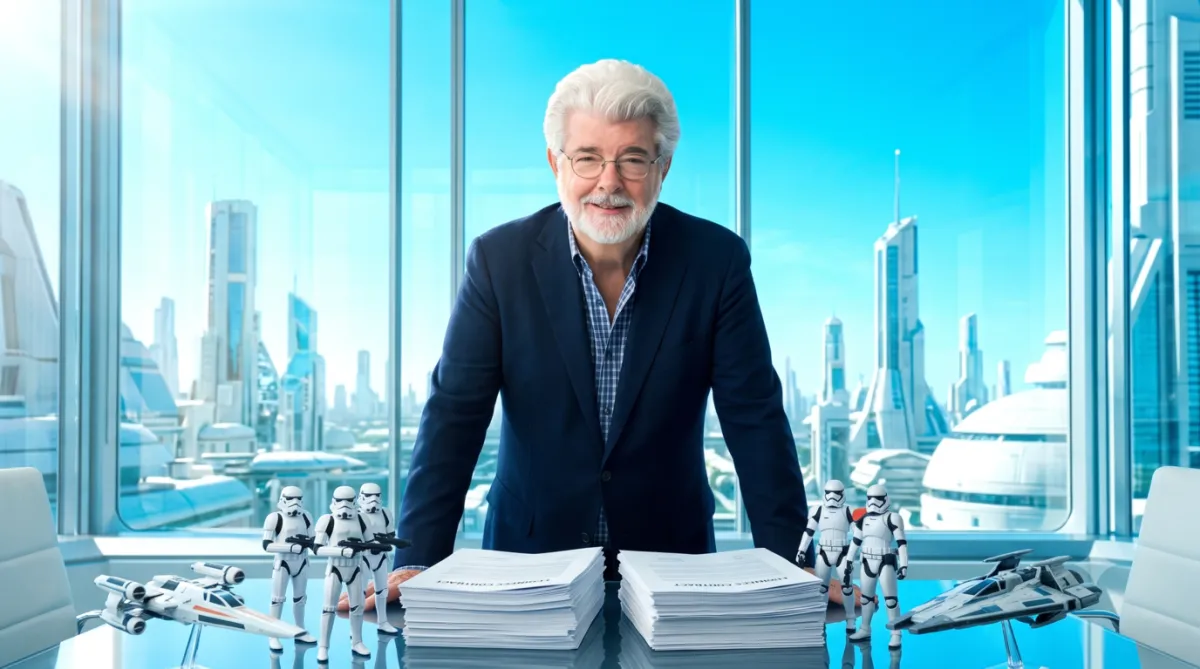
The Backend Empire
The $73 Billion Jedi Mind Trick That Will Change How You Do Business
The Greatest Negotiation in Hollywood History
Let's talk about the biggest flex in the history of business. If you're still living deal-to-deal, grinding your life away for that one-time upfront commission, you're playing a rigged game. It's time to stop thinking like a hungry middleman and start thinking like an empire builder. You need to drop the transactional hustle and build an ecosystem - a money machine that pays you on repeat.
To understand how to pull this off, let's jump in a time machine back to the 1970s. Back then, Hollywood studios were basically glorified transactional loan brokers. They made a movie, sold some tickets, took their cash, and completely forgot about it. What about sequels? Please. To them, sequels were just high-risk garbage fires that made half the cash of the original (looking at you, Jaws 2).
Enter George Lucas. This guy had some serious trust issues. His first movie, THX 1138, got absolutely butchered by the suits at Warner Bros. They chopped his movie up without his permission, and Lucas basically swore a blood oath to never let corporate executives touch his work again. He needed absolute control, period.
Luckily, his next flick, American Graffiti, was made for absolute peanuts - under $800,000 - and raked in over $100 million. Boom. Suddenly, Lucas wasn't just a nerdy kid with a camera; he was a walking ATM. He had the one thing you need to completely flip a corporate contract on its head: leverage.
So, Lucas walks into 20th Century Fox to pitch Star Wars - a bizarre, risky space movie about laser swords and giant walking carpets. Fox greenlights it for $11 million but secretly thinks it's going to bomb hard.

Lucas was supposed to get a standard $500,000 director's fee. But instead of snatching the upfront cash like a desperate amateur, he pulls the ultimate Jedi mind trick. He tells the studio, "Keep $350,000 of my fee. I'll do it for $150,000." (That's right, he took a massive loss on the front end).
But here's the hook: in exchange for saving the studio that upfront cash, Lucas demanded 100% of the sequel rights and majority control of all the merchandising. Fox executives probably laughed themselves to the bank, thinking they just fleeced this guy. Meanwhile, Lucas just wanted to sell some t-shirts to market his weird movie and make sure no studio could ever hijack his sequels. Fox thought they saved 350 grand. In reality, they just handed over the keys to a multi-billion dollar empire.
Short-Term Cash vs. Long-Term Empires
Why did Fox say yes? PTSD, mostly. Back in 1967, they tried building a massive ecosystem around Doctor Dolittle. The budget ballooned from $6 million to $14.4 million, and the movie absolutely tanked, making a pathetic $6.2 million domestically. Fox got stuck eating up to $200 million in unsold retail stock, which nearly bankrupted the damn studio. By 1976, they viewed merchandising as toxic waste. They optimized purely for short-term balance sheet protection. Lucas, on the other hand, was playing 4D chess - optimizing for long-term Customer Lifetime Value (LTV).
Now, look in the mirror. The industry standard for loan brokers, mortgage loan officers, and credit repair pros is just as short-sighted. You're out there chasing those upfront, one-time commissions. This traps you on a miserable treadmill of perpetual lead generation, volatile revenue streams, and complete dependence on whatever the interest rate environment decides to do today. You're playing the "box office" game, and it's a grind.
Amateurs try to squeeze every last drop of profit out of the very first transaction. The pros - like Costco, MrBeast, and Lucas - use that first transaction like a cheap rotisserie chicken. It's just a loss leader to get the customer in the door.

If this sounds familiar, it should. Taking a pay cut on the front end to own the back end is the exact same "Red Ink" Cheat Code that MrBeast uses today (See our previous MrBeast article here). Lucas's $500,000 pay cut in 1973 was just the Hollywood version of MrBeast dropping $4 million on a YouTube video. Neither of them were trying to make money on the video itself. They were buying the world's most valuable asset: a captive audience that they could monetize forever.
The Financial Aftermath & The Cheat Code (Building Your "Merchandising" Ecosystem)
So, what happened when the movie actually hit theaters? It casually pulled in $775.4 million globally. If we adjust for inflation, that's a monstrous $4.27 billion in 2026 dollars. But here's the secret - Lucas didn't even care about that front-end money. To him, the movie was just the most expensive lead-generation tool ever created.
You see, Hollywood accounting is notoriously shady. Studios constantly claim their biggest blockbusters never turn a "net profit" on paper. Just ask David Prowse - the guy inside the Darth Vader suit - who famously got screwed out of his residuals. Lucas knew this game was rigged. He bypassed the studio's funny math entirely by owning the gross revenues of the physical merchandise. The suits couldn't hide the toy money.
When it came time to make the actual toys, Kenner Toys agreed to a $100,000 flat fee and a tiny 5-cent royalty per dollar sold. But consumer demand was so insane that Kenner literally ran out of plastic. Their solution? They sold an "Early Bird Certificate Package" - which was literally an empty cardboard box - for $7.99 (about $44 bucks today). People paid real money for an empty box that promised a toy months later. In its first year alone, Star Wars merchandise grossed $100 million. That's over half a billion in 2026 dollars.

Because Lucas held the sequel rights, he didn't need Fox's money anymore. He independently financed The Empire Strikes Back and Return of the Jedi. He walked back into the studio, dictated his own terms, and kept up to 77% of the theatrical gross. He was the bank now.
Let's look at the ultimate scoreboard. The lifetime revenue of the franchise sits somewhere between $46.7 billion and $73.7 billion. The box office accounts for about $10.3 billion of that. The backend merchandise? A staggering $29 billion to $42 billion. The backend crushed the front-end by a 4-to-1 ratio. And the grand finale? In 2012, Lucas sold the intellectual property to Disney for $4.05 billion - nearly $6 billion in today's money. Not bad for a guy who took a pay cut.
Lucas knew the movie was just a two-hour commercial to sell plastic toys. MrBeast knows his $4 million videos are just commercials to sell Feastables chocolate bars.
Here's the translation for your business. That initial credit repair fix or single term loan you're sweating over is just your commercial. Stop being greedy on day one. Take a reduced margin, or offer free audits, just to win the client and capture their data. The real wealth is the recurring backend.
Modern Business Frameworks & Stop Giving Away Your Rights
Let's look at how the big boys play the game today. First up, we have the classic "Razor-and-Blades" model. Gillette will practically hand you a razor handle for pennies just to embed their plastic into your morning routine. Why? Because the real cash comes from the high-margin replacement blades you are forced to buy every single month. It's a very simple math equation. You bleed a little on the hardware, and you make an absolute fortune on the refills.

For those who absolutely hate algebra, here is the plain English formula:
Lifetime Value = (Profit on Monthly Refills x How Long They Stick Around) minus The Cost of Headaches (like refunds and customer support).
Next, you have the Fintech Data Monetization engine. Think about Credit Karma. They offered everyone and their mother a free credit score. Do you have any idea how incredibly expensive that overhead is? They didn't care. They used that free tool to harvest high-intent data from 130 million users. Then, they monetized all that juicy data through a massive backend affiliate engine, slinging credit cards and personal loans. Intuit ended up buying them for $7.1 billion - which is well over $9 billion in 2026 dollars.
Now compare that masterclass to Mint. Mint acquired 13 million users but completely forgot to build a backend cross-selling engine. They hemorrhaged cash until Intuit eventually shuttered them. A front-end without a back-end isn't a business - it's an expensive charity.
Then you have Unified Commerce and Quote-to-Cash (Q2C) workflows. This is where you shift to a Unified Customer Experience (UCX). You track post-transaction behavioral data and use predictive analytics to forecast exactly when a client might churn or when they are primed for an upsell. You stop sweating the initial gross margin and focus entirely on Monthly Recurring Revenue (MRR).
But here is the fatal flaw - the trap that catches everybody. There is a massive gap between spending the money and making it back. Just like we talked about with MrBeast, you need a "War Chest" to float that gap. You can't run a loss leader if you are living paycheck to paycheck.
This brings us to the ultimate middleman mistake. When you refer your hard-earned clients to an outside lender for a tiny finder's fee, you are literally giving away your merchandising rights. You are throwing away your enterprise value. That third-party lender takes your client's data and they will market to them forever. He who controls the data controls the capital. Period.
Architecting the Empire & The Solution
Stop trying to bleed your client dry on deal number one. Use the Fintech playbook. You hook them by running an internal, AI-driven analysis of their credit to map out a custom funding strategy. You provide that upfront value to absorb the high Customer Acquisition Cost (CAC) and get them in the door.
Once they are in, you build the ecosystem.
A funded deal isn't a finish line; it's a ticking financial clock. Businesses grow, and growth takes cash. When you control the ecosystem, you aren't just selling a one-off loan. You start them with a quick working capital injection. Then, your system tells you they are primed for 0% business lines of credit. A year later, when they need to buy trucks or open a second location, you are right there to cross-sell equipment financing and massive term loans.

Whether you are a mortgage LO looking to add commercial capital to your real estate toolbelt, or a credit repair pro ready to completely pivot into the big leagues, the math is exactly the same.
Look at the ultimate scoreboard.
The Transactional Broker spends $2,500 on CAC, earns a $5,000 commission on a one-off deal, and nets $2,500. Then they drop back to zero, stare at a blank pipeline, and have to spend another $2,500 just to eat next month. It's a miserable hamster wheel.
The Ecosystem Broker spends that exact same $2,500 CAC for the initial $5,000 upfront win. But later? They stack the client with business credit cards (pocketing more commission), fund the equipment for their new warehouse ($4,000 commission), and land a massive expansion term loan a year later ($7,000 commission). Total Lifetime Value scales to $18,500. Zero new marketing spend. Your margins just expanded geometrically.
But here is the reality check: you can't build a B2B funding ecosystem using a messy spreadsheet and a Rolodex. You can't be an ecosystem broker if you don't have the infrastructure.
Enter The Funding Machine.
It is the all-in-one software required to control the transaction. It gives you the AI-driven credit analysis tools to hook the client on the front end, and the massive lending marketplace - term loans, lines of credit, and working capital - to build your empire on the back end.
Stop playing the transactional game. Cease chasing the box office, and begin architecting the empire. Watch our free case study to see exactly how to build your own backend funding ecosystem today.