Why Jeff Bezos Doesn't Pay Taxes (And You Do)
How the ultra-wealthy use strategic "losses" and OPM to build empires and legally starve the IRS.

Let’s go back to the late 90s. The traditional financial establishment looked at Jeff Bezos and laughed right in his face.
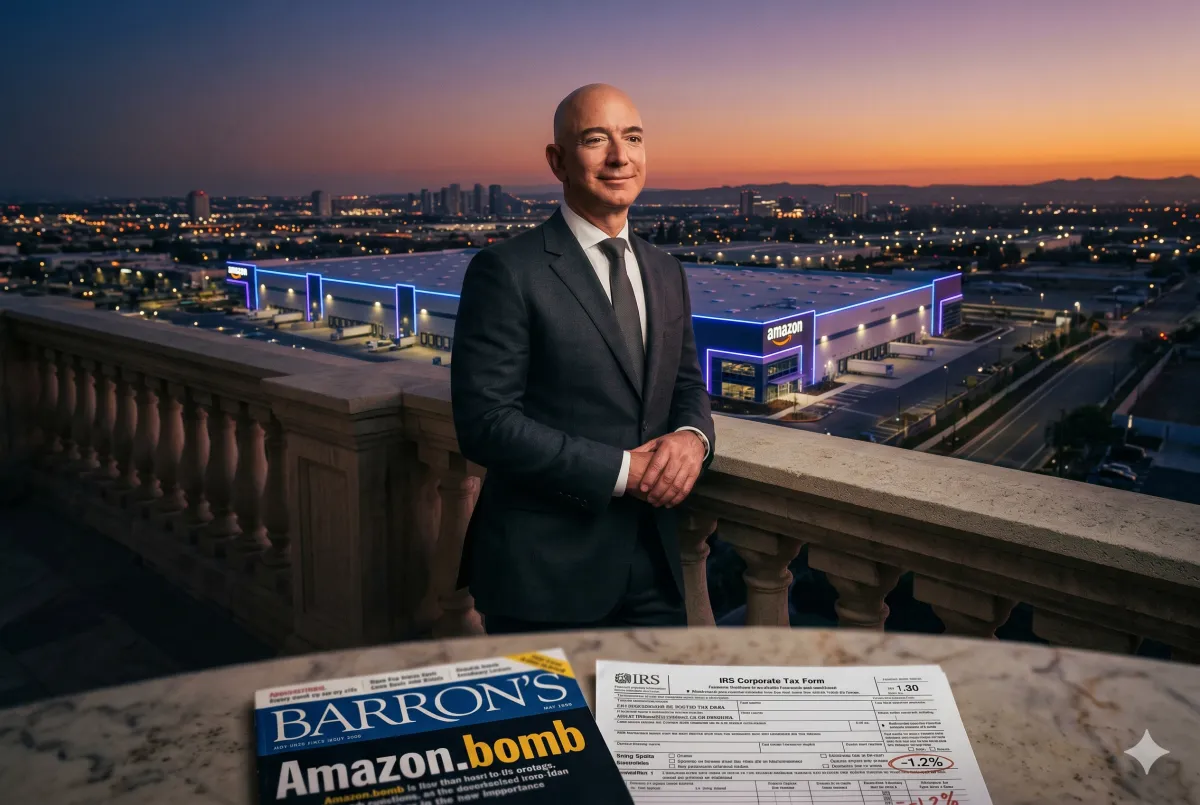
Wall Street analysts, who are completely obsessed with short-term, immediate profits, thought Amazon was a cash-incinerating disaster. On May 31, 1999, a highly respected financial magazine called Barron’s published an infamous cover story literally calling the young company "Amazon.bomb." 💣
The market agreed with the haters, and the stock eventually plummeted by 95%, crashing from over $220 down to under $6 a share. The media confidently wrote his obituary, calling him a terrible businessman who just couldn't figure out how to turn a profit. 📉
But Wall Street was playing checkers, and Bezos was playing chess. ♟️
He wasn't failing to make money; he was intentionally operating at a "loss." Instead of hoarding cash in a bank account just to show a shiny profit to the public, he was aggressively reinvesting every single dime of his revenue back into the company's physical infrastructure.
Why? To intentionally wipe out his taxable income.
He actually warned everyone he was going to do this. In his famous 1997 shareholder letter, he explicitly stated that if forced to choose between looking good on paper for the accountants or maximizing actual, long-term cash flow, he would choose the cash flow every single time.
Fast forward a few years, and we have the brutal, undeniable mathematical proof of this "loss" strategy.
In 2017, Amazon pulled in a staggering $177.8 Billion in sales. Do you know what they paid in federal corporate income taxes on that absolute mountain of money?
Exactly $0. 🤯
It gets even crazier. In 2018, they posted $10.8 Billion in U.S. profit. Not only did they pay zero taxes, but they actually received a $129 Million tax rebate from the government. That brought their effective tax rate to a negative 1.2%.
The IRS got absolutely nothing, the public was outraged, and Bezos quietly built a $1.8 Trillion monopoly. 🏦
He didn't break the law. He just read the rulebook.
The Middle-Class Tax Trap (Chasing the Wrong Metric)
Most traditional accountants are fantastic at keeping you out of jail, but they are absolutely terrible at making you wealthy.
From the day you register your LLC, they teach you to worship at the altar of "Net Profit." The script is always the same: Keep your expenses as low as humanly possible, hoard your cash in a business checking account, and at the end of the year, stare at that big, fat number at the bottom of your P&L statement to prove to yourself that you finally "made it." 🏆
We have been completely conditioned to believe that logging into the bank portal and seeing a massive pile of cash sitting idle is the ultimate entrepreneurial flex.
But here is the reality check that separates the amateurs from the titans: To the ultra-wealthy, "profit" isn't a trophy. Profit is simply capital that you lacked the imagination to reinvest. 🧠 Read that last sentence again!
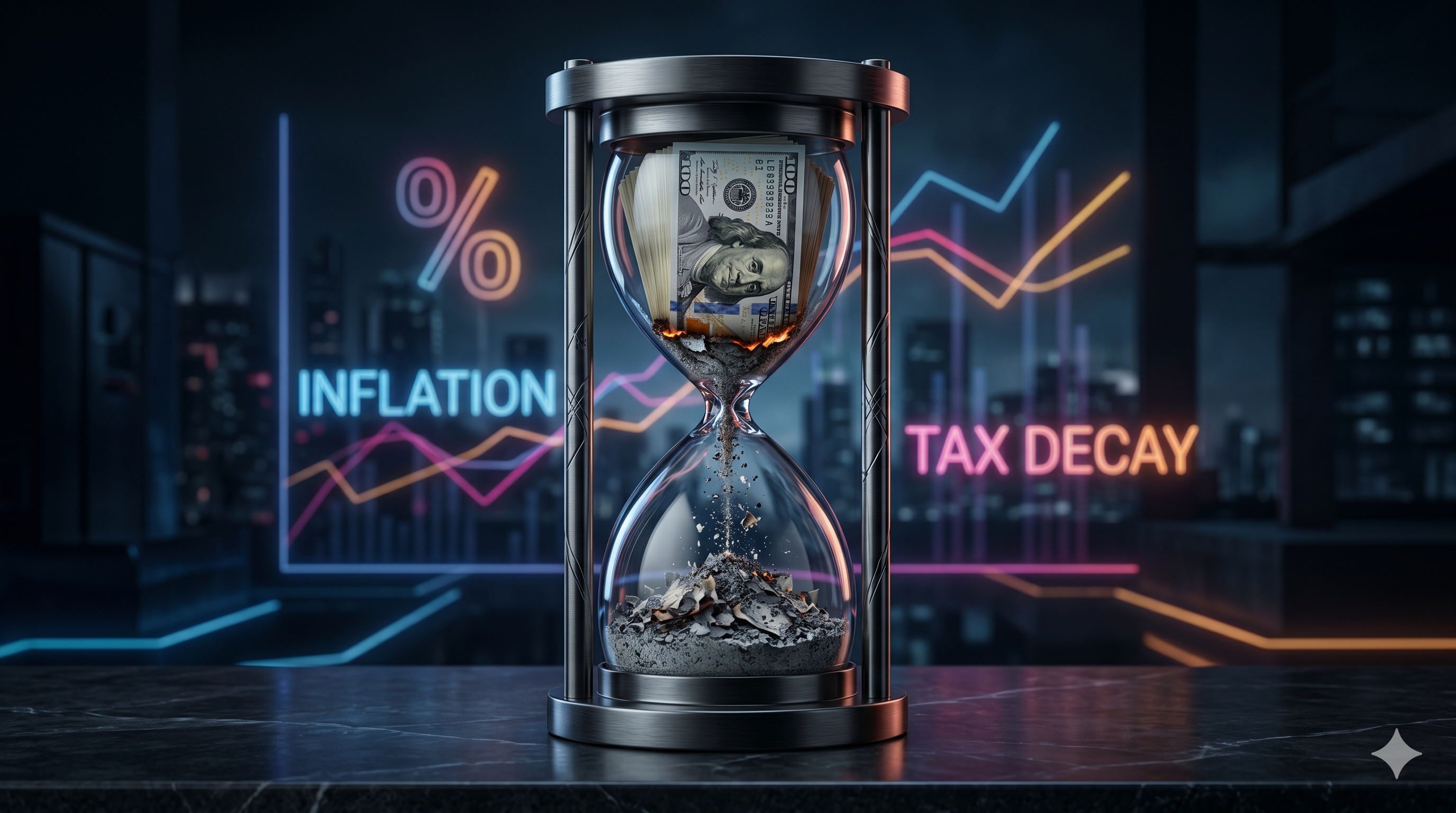
When you leave that money sitting dead in a checking account, you trigger the devastating Cost of Stagnation. You are essentially raising your hand and telling the government, "I don't know how to use this money to grow my business anymore, so you can just have it."
And the IRS will gladly oblige. Because you left that cash exposed, the government steps in and legally confiscates 30% to 40% of it in taxes. Then, whatever scraps you manage to save are immediately attacked by inflation, which quietly eats away at your purchasing power every single month. By playing it "safe," you are guaranteed to lose. ✂️
Breaking out of this trap requires a massive shift in how you view status and wealth.
Poor and middle-class operators optimize their entire lives for cash. They want to see the money right now so they can feel secure.
Wealthy operators optimize for Enterprise Value (EV). Enterprise Value is simply what your entire money-making machine would be worth if you sold it to someone else tomorrow.
Bezos didn't care about the cash balance in his checking account; he cared about building a physical monopoly. He knew that taking a $100,000 "profit" meant he would instantly lose up to $40,000 to the IRS. But if he took that same $100,000 and bought a delivery truck, he increased his Enterprise Value, kept the wealth safely inside his empire, and owed the government absolutely nothing. 🚚
Let this harsh truth sink in: A massive tax bill at the end of the year isn't a sign that you are highly successful. It is a voluntary penalty you pay for financial illiteracy.
The Mechanics of the Cheat Code (CapEx & Depreciation)
To actually execute this billionaire strategy, you need to understand the fundamental difference between how the middle class spends money and how the elite deploy capital. It all comes down to two simple accounting terms: OpEx and CapEx.
OpEx (Operating Expenses) is the money you spend just to keep the lights on. It’s your software subscriptions, your office rent, and your Facebook ads. When you spend OpEx, the money evaporates. It does a job, and then it is gone forever. 💨
CapEx (Capital Expenditures) is money you spend to buy physical, heavy-duty assets. It is buying the building, the delivery fleet, or the massive server racks. When you spend CapEx, the money doesn’t evaporate. It simply changes form. It moves from cash in your bank account into a durable asset that sits on your balance sheet and creates long-term wealth. 🏗️
Here is the ultimate secret the wealthy understand: The government actively rewards CapEx.
The IRS isn’t a grim reaper trying to arbitrarily punish you; the tax code is actually a highly programmable rulebook designed to reward entrepreneurs who build infrastructure and stimulate the economy.
If you build, they shield you. 🛡️
Right now, in 2026, there are two massive, legal cheat codes sitting right out in the open. The first is the Section 179 deduction, which currently allows you to write off up to $2,560,000 in qualifying equipment. The second is the permanent 100% Bonus Depreciation reinstated under the One Big Beautiful Bill Act (OBBBA).
In plain English? This means the government is allowing you to deduct the entire purchase price of a massive asset from your income in the exact same year you buy it.
Let’s run the brutal, undeniable math on a normal, six-figure business.
Let's say you grind all year and generate $100,000 in pure net profit.
The Amateur Play: You leave that $100k sitting in your checking account to look at it. Come tax time, the IRS takes roughly $30,000 of it. You are left with $70,000, and your business hasn't grown an inch. 📉
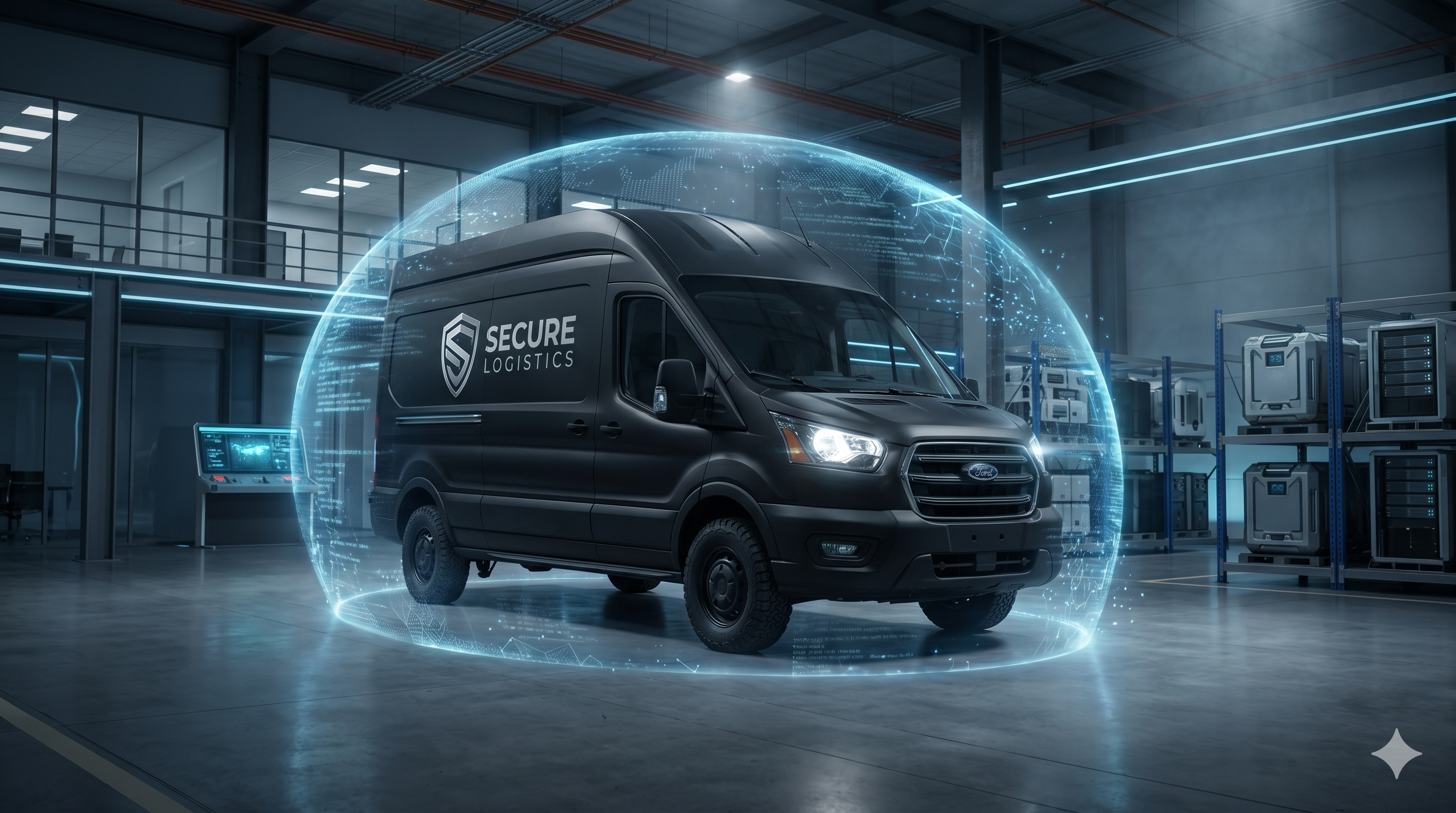
The Titan Play: Before December 31st, you take that $100,000 and buy a heavy commercial vehicle - let's use a Ford Transit van as an example. Because the van exceeds the IRS’s 6,000 lbs Gross Vehicle Weight Rating (GVWR) requirement, it qualifies for the heavy equipment tax codes.
You apply the 100% deduction. On paper, you subtract that entire $100,000 purchase from your profit.
Your new taxable net income? $0. The amount you owe the IRS? $0. 🚐💸
You didn't "lose" $100,000. You simply transferred it from a highly taxable liquid state (cash) into a completely tax-free solid state (an asset). Even better, that van is now going to go out into the world and generate brand new revenue for your business every single day.
You starved the IRS, and you funded your empire.
The Bezos Blueprint (The AWS Masterstroke)
Let’s look at the greatest execution of this CapEx cheat code in modern history.
Back in the early 2000s, Amazon had a massive, expensive problem. Every November and December, holiday shoppers would absolutely flood the website. To keep Amazon.com from crashing under the weight of the Black Friday rush, Bezos had to purchase an absurd amount of heavy computer servers. 🖥️
A traditional, middle-class operator would look at that massive expense, panic about the cost, and try to cut corners. Bezos looked at it and saw the ultimate tax shield. He authorized the massive Capital Expenditure (CapEx), bought the heavy server racks, and used the depreciation rules we just talked about to legally wipe out his retail tax bill. The government rewarded him for building infrastructure, and his taxable profit vanished.
But here is where the story turns into a financial heist movie. 🎬
Once the holidays ended and January rolled around, Amazon's internet traffic naturally dropped back down to normal levels. Suddenly, Bezos had warehouses full of hyper-expensive, tax-deducted servers just sitting there, completely idle for ten months out of the year.
Most founders would have looked at those idle servers as a sunken cost - a necessary evil just to survive the winter. Instead of letting that hardware collect dust, Bezos made a ruthless pivot in 2006. He decided to rent out that excess, tax-shielded server capacity to other businesses and startups.
He called it Amazon Web Services (AWS). 🌩️

Think about the sheer, undeniable genius of this move. He used tax-deductible infrastructure spending - purchases he made purely to protect his retail store and starve the IRS - to accidentally build the most profitable cloud computing company on earth. By 2025, that "side project" generated a staggering $45.6 billion in operating income.
And if you think this is just ancient history from the dot-com era, look at what Amazon is doing right now. The game hasn't changed; the price tag just got bigger.
Enter the artificial intelligence boom. To dominate the AI race, Amazon needs unimaginable computing power. So, in 2025 alone, they poured a mind-bending $96.5 billion into AI data center CapEx. 🤖
They didn't just do that to build better AI. They did it because the tax math is mathematically undefeated. By aggressively deploying that $96.5 billion into physical infrastructure, they legally slashed their corporate cash tax bill by 87%.
Let me repeat that. By aggressively buying assets, they saved themselves nearly $7.8 billion in taxes in a single year. 💰
They took $7.8 billion that was supposed to go directly to the IRS, kept it entirely in-house, and used it to fund even more aggressive expansion.
This is how the titans play the game. They never, ever leave their profit sitting exposed as cash. They constantly cycle it into heavy assets, legally zero out their tax liability, and use the new infrastructure to create entirely new revenue streams. ♟️
The Founder's Pivot (Translating Billions to Thousands)
At this point, you are probably rolling your eyes and thinking, “This is great for Jeff Bezos, but I’m a normal founder. I don't have billions of dollars in a corporate treasury to go out and buy heavy equipment.”
You are absolutely right. You don’t have billions in cash.
But here is the ultimate punchline to this entire financial heist: You don't need your own cash. 🤯
This is where we move from billionaire theory into the actual, actionable cheat code for the everyday founder. The secret lies buried deep inside a highly boring government document called IRS Publication 946.
Inside that publication, the IRS explicitly states a rule that completely changes the game for small businesses: “You are considered to own property even if it is subject to a debt.”
Read that twice. The government is telling you, in black and white, that you get 100% of the massive CapEx tax write-off for an asset, even if you used the bank's money to buy it. 🏦

You don't have to drain your personal savings. You don't have to empty your business checking account. You just need to understand how to use Other People’s Money (OPM).
Here is the exact playbook we call the 0% Leverage Loop.
Instead of using your own hard-earned profit to buy infrastructure, you utilize a backdoor strategy called 0% Business Credit Stacking. If you have a decent personal FICO score (anything 680 or above) and a clean payment history, you can systematically stack promotional business credit lines to secure up to $100,000 in unsecured bank capital. 💳
Once the vault opens, you use the bank's money to buy that heavy Ford Transit van, or that massive server rack, or that $50,000 piece of high-end manufacturing equipment before December 31st.
Look at the absolute beauty of this math:
You instantly evaporate your $30,000 tax liability because you made a qualifying CapEx purchase.
You get to keep your $100,000 in actual business profit sitting safely in your bank account for real emergencies.
You pay exactly 0% interest on the borrowed money for the next 12 to 24 months.
While you are floating that 0% loan, the new asset is out in the field generating brand new revenue. The asset literally pays off its own debt, the bank makes zero interest off you, and you legally starve the IRS. ♟️
You just played the exact same game as Jeff Bezos, and you didn't even use your own money to do it.
Stop Funding the IRS, Start Funding Your Empire

Let’s wrap this up with one final, brutal reality check.
Every single dollar you pay in unnecessary taxes isn't just a normal "cost of doing business." It is vital capital being violently extracted from your empire's future. The middle class complains about the IRS, but the elite realize the tax code isn't a punishment - it is a highly programmable rulebook literally begging you to build, buy, and scale. 🧱
But to play this billionaire game, you can't be scraping the bottom of your personal checking account. You need leverage to execute this financial arbitrage.
We built the Funding Machine to completely automate the capital stack for founders just like you. We bypass the traditional banking gatekeepers to secure the $50k to $150k in 0% capital you need to buy real assets, crush your tax liability to zero, and rapidly scale your Enterprise Value. 🚀
It is time to stop playing small. Stop funding the government, and start funding your own empire.
Click here to watch the free case study and see exactly how to secure your 0% capital today.