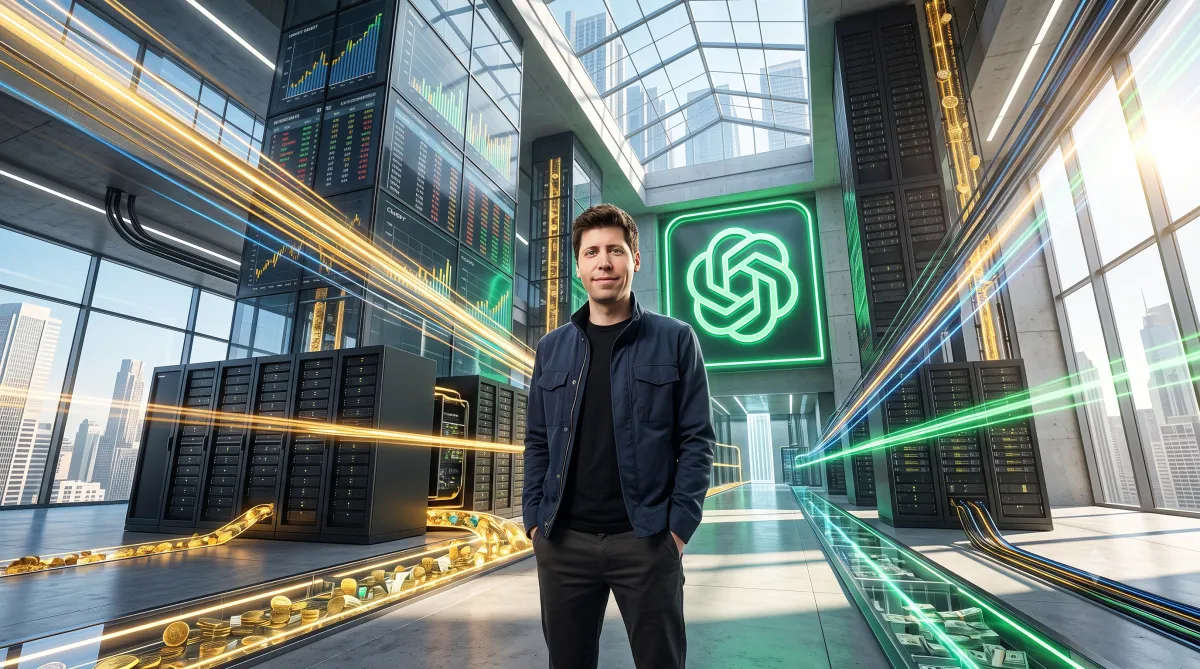
Sam Altman Didn't Code ChatGPT. He Funded It.
Why the Greatest Tech Revolution in History Was Won by Capital Allocation, Not Code.
Everyone loves the story of the lonely genius in a hoodie. You know the one. The guy who sits in a dark garage, furiously typing away until he magically builds a massive tech empire. The media loves to sell you this fairy tale because it sounds inspiring. But in the modern business world, it is a complete lie.
The artificial intelligence revolution was not won just because some guys wrote a better algorithm. It was won by heavy financial engineering. It was won by an absolute mastery of institutional wealth.

Look at Sam Altman. People look at him as the mastermind of ChatGPT. But Sam Altman did not sit down and code the machine. He funded it. His real superpower is not writing software - it is acting as the ultimate financial architect. He engineered the massive pile of cash required to buy up the market before the competition could even react.
The OpenAI Cash Burn Reality
Let me tell you a hard truth about business. Bootstrapping a massive AI model is not just hard. It is mathematically impossible.
You cannot save your pennies to build the future. You cannot run a bake sale to compete with the big boys in this space. If you try to bootstrap a project this big, you will fail before you even write your first line of code. Let us look at the actual math behind the curtain.
When they built the GPT-3 model, they did not just plug in a couple of fast laptops in a basement. They had to use a massive cluster of 10,000 NVIDIA Tesla V100 GPUs.
It took 355 GPU-years of raw power just to train the thing. That cost them an estimated $4.6 million purely in cloud compute time. And remember, that was just the baseline cost to get their foot in the door.

It only got worse from there. As the AI models grew in size, the financial bleeding grew right along with them. It was an absolute hemorrhage of cash.
Sam Altman actually went out and publicly confirmed the insane numbers. He admitted that the training costs for the new GPT-4 model went way over the $100 million mark.
Think about that for a second. More than $100 million just to train the product.
Most small business owners panic when they have to spend a thousand dollars on a basic marketing campaign. These guys were dropping nine figures before the product was even fully ready to go. They were playing a totally different game.
But here is the real kicker. The costs do not just stop after the training phase is over. That is just the setup. Running the machine is where the real nightmare begins.
When millions of people started using the system, the server costs exploded. In the year 2023, just running ChatGPT cost them an estimated $700,000 every single day.
Every time you typed a stupid question into the chat, they were burning money. They were setting hundreds of thousands of dollars on fire every 24 hours just to keep the lights on.
Let us look at the most recent numbers to see the real damage. It is a complete financial bloodbath.
The internal financial records for the year 2025 came out, and the numbers are absolutely staggering. They actually made some great money on paper. They brought in $13.07 billion in revenue.
Most people would kill for that top line. But they incurred a massive $34 billion in total costs.
Do the math on that. That resulted in a catastrophic operational loss of $20.92 billion. They lost nearly $21 billion in a single year.
Now, you might look at that and think they are failing. You might think they are stupid. But they are not. This massive burn rate is completely intentional. They know exactly what they are doing.
The internal projections show that their cumulative operational losses will hit a staggering $44 billion by the year 2028. That is the year they finally plan to reach actual profitability.
They are not losing money because they are bad at business. They are intentionally burning capital to buy up the entire global market before anyone else can catch up.
The Architect & The Deal Mechanics
When you are bleeding billions of dollars, a regular corporate structure just will not cut it. Sam Altman knew he had to rebuild the company to survive the massive cash burn.
OpenAI started out as a basic nonprofit. But a 501(c)(3) status has strict limits on how much money you can raise. You cannot round up billions of dollars from Wall Street when you are set up like a charity.
So, in the year 2019, Altman engineered a clever workaround. He built a complex, capped-profit subsidiary designed to pull in massive institutional wealth.
To get the financial elite to hand over their cash, Altman offered an insane incentive. This new structure allowed early investors to earn up to a 100x return on their capital. That massive upside reeled in the exact liquidity they needed to keep going.

Then came the absolute masterstroke: the monumental 2023 deal with Microsoft. Altman convinced them to drop a cool $10 billion into the company. The mechanics were beautifully aggressive. Microsoft secured the rights to 75% of OpenAI's profits until the aggregate investment was fully recouped.
But here is where the true financial genius comes in. Microsoft did not just wire Altman a giant pile of liquid cash. The vast majority of Microsoft's $10 billion investment was structured as Azure cloud compute credits rather than liquid cash.
Why is that brilliant? Because he did not need paper money. He needed raw server power. He secured the exact infrastructure needed to run the models without giving up extra ownership.
But Altman is always three steps ahead. If you rely on just one giant company for all your power, they eventually own you. He had to break their grip.
So, by early 2026, OpenAI formalized a $50 billion strategic deal with Amazon Web Services. This massive deal was designed to consume 2 gigawatts of Amazon's custom AI chips. By doing this, he was completely restructuring its capital stack to operate across multiple hyperscalers.
He ended Microsoft's exclusivity in one move. He did not code a single thing, but he owned the board.
Historical Parallels: Capital Velocity & Buying Market Share
Operating at a massive, subsidized loss to permanently capture a monopoly is not a new idea. It is the exact playbook of the modern internet era.
Look at the Amazon blueprint. Back in 1999, Amazon reported a pro forma net loss of $390 million on $1.64 billion in sales. They were spending hundreds of millions of dollars to aggressively expand their physical warehouse footprint.
They sustained these massive losses through a clever manipulation of working capital. Specifically, they maintained a negative Cash Conversion Cycle of -33 to -55 days. (See our previous article on Amazon and Jeff Bezos here!)
Amazon historically collected its cash from customers in just 21 days. But they delayed paying their own suppliers for up to 95 days. They effectively forced their suppliers to finance their massive operational expansion.

We saw the exact same thing in the ride-share wars. In 2015, analysis showed that Uber passengers were paying only 41% of the actual cost of their trips. The remaining 59% was completely subsidized by venture capital to starve out and crush the traditional taxi industry.
Netflix conquered media using the exact same velocity-driven capital strategy. They scaled their negative free cash flow to a staggering -$3.3 billion by 2019 just to finance original programming. They used cheap debt to build a structural content moat that legacy media could not touch.
The Bootstrapper's Trap & The Funding Machine Solution
Let us talk about the everyday CEO. You have been told to play it safe. You have been told to save your money and grow slowly. But playing it safe is exactly what kills you.
The harsh reality is right there in the data. A staggering 82% of small businesses fail simply because they run out of cash.
People love to brag about bootstrapping. They love to puff out their chests and say they own 100% of their company. But 100% of a dead business is still nothing.
While you are busy protecting your equity, you are walking into a trap. Bootstrapped startups face a massive 70% failure rate. It takes them an average of 18 months just to see a single dollar of profit.
By the time you finally save up enough money to scale your operations, a well-funded competitor has already stolen your entire market.

Contrast this with the Silicon Valley elite. They do not play by your rules. The institutional mindset relies on a strategy called Blitzscaling.
When the market is uncertain, they prioritize pure speed over financial efficiency. They know that capital is a weapon, and whoever moves the fastest takes all the chips.
This is exactly why we built the Funding Machine. You are not just the creator of your product. You are a capital allocator. Stop trying to out-work a lack of money. Plug into the system, get the capital you need, and go buy your market share. Join us for our next Funding CEO Challenge to see how you can apply these principles in your business while helping others get the capital they need!