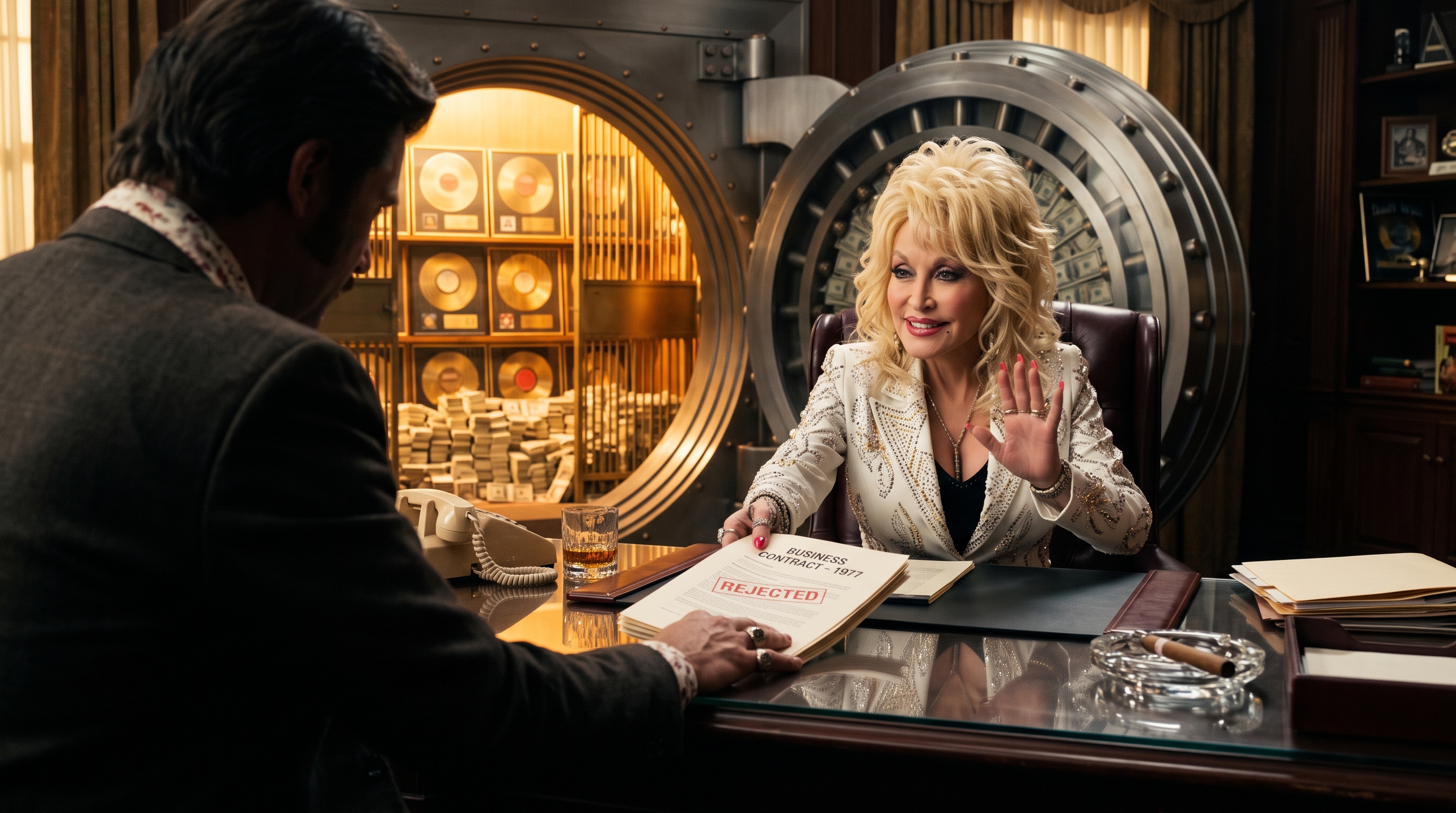
The Day Dolly Said NO to The King
Why giving up too much of the pie is a catastrophic business error
We lost an absolute legend this week. Dolly Parton passed away at the age of 80, leaving behind a massive cultural legacy and a staggering estimated net worth of $650 million. But let's get one thing totally straight. She didn't build a financial empire of that size just by wearing heavy rhinestones, telling jokes, and playing the guitar.
The real pillar of her wealth was her ruthless, unencumbered ownership of her publishing catalog. While other musicians were busy trading away their rights for quick cash and a fleeting moment in the spotlight, Dolly treated her songs as long-term financial assets. She wasn't in the business of creating disposable commodities. She was building a financial fortress, and she refused to let anyone else hold the keys to the front door.

Let's jump back to 1973 to see exactly how this works. Dolly was finally ready to launch her solo career and leave her long-time mentor, Porter Wagoner. To say a professional goodbye without completely burning the bridge, she sat down and penned "I Will Always Love You". She was just trying to write a nice, heartfelt farewell tune. What she actually did was unknowingly mint one of the most valuable pieces of intellectual property in human history.
The Conflict: Elvis vs. The Equity
Fast forward just one year to 1974. The song hits number one on the country charts, and the biggest star on the planet takes notice. Elvis Presley hears the track and decides he is going to record his own version.
For a country songwriter in the 1970s, getting a cover from The King was the ultimate golden ticket. It was a guaranteed explosion of fame. It meant a massive upfront payday and a permanent spot in music history. Dolly was beyond thrilled. She was literally packing her bags to head to the studio and watch Elvis sing her song.
But then the phone rings. It is the afternoon right before the scheduled recording session. On the other end of the line is Elvis's notorious manager, Colonel Tom Parker.
He wasn't calling to chat about the musical arrangement. He wasn't calling to see how she was doing. He was calling to enforce an absolute, non-negotiable corporate policy. Parker laid down the law.
He told Dolly that Elvis doesn't record anything unless his publishing company gets 50 percent of the publishing rights. In the gritty reality of the music business, this predatory shakedown was colloquially known as the "Elvis tax".
It was a ruthless cut-in deal explicitly designed to extract massive, long-term wealth from desperate songwriters. Parker operated on a very simple premise. He knew most writers would happily sign away their financial future.
They would give up their equity just to get their name attached to Elvis. Parker was selling them short-term vanity while stealing their long-term cash flow. But Parker completely underestimated the businesswoman on the other end of the phone.
Dolly knew exactly what she had built. She recognized that this specific song was the most important copyright in her entire catalog. Instead of folding like a cheap card table, she flatly refused to surrender her foundational asset.
She stared down the biggest, most intimidating dealmaker in the entire entertainment industry. She simply told him, "That is not possible."
Let's be totally honest about the gravity of this move. Rejecting Elvis Presley in 1974 was practically unheard of. Everyone in town thought she was completely insane for blowing the opportunity of a lifetime. The emotional toll of maintaining that kind of financial discipline was severe.
Dolly later admitted that she "cried all night" after walking away from the deal. It absolutely broke her heart, but she wiped her tears and stood her ground to protect her equity. She knew that keeping 100 percent of the pie was worth way more than a quick photo op with The King.
The Math: The Catastrophe of a 50% Cut
Let's break down the actual math here, because the absurdity of this deal is staggering. Giving up 50 percent of the publishing rights didn't just mean splitting the royalties on one single Elvis record.
It meant surrendering half the ownership of the underlying composition itself in perpetuity. It meant giving up 50 percent of the profits regardless of who recorded the song ten, twenty, or fifty years down the line.
Think about how completely insane that is. Surrendering that kind of equity is financially equivalent to handing over half the deed to your entire apartment building just because a single tenant agreed to sign a lease.

If Dolly signed that contract, she'd be paying a permanent 50 percent tax on the lifetime earnings of her asset to a guy who contributed absolutely zero creative capital.
Now, let's pivot to the modern business landscape. You might think you'd never make a deal that bad, but founders make this exact same mistake every single day.
Colonel Tom Parker's predatory Elvis tax is still alive and well. Today, we just call it the Merchant Cash Advance, or the MCA trap.
Modern business owners are constantly trading massive chunks of their daily revenue and future equity for a quick, short-term cash infusion - including from venture capitalists as well (See our Shark Tank article here). They get completely blinded by the upfront capital, just like a hungry songwriter getting blinded by the chance to work with The King.
They sign the paperwork and let a predatory lender take a daily cut of their sales. They permanently cripple their cash flow and starve their own growth, all for a temporary vanity boost.
The Payoff: The Whitney Houston Multiplier
Let's fast forward the timeline a bit. We jump ahead almost two decades to 1992. A little movie called "The Bodyguard" hits the theaters, and it completely changes the trajectory of music history.
For the soundtrack, Whitney Houston decides to step up to the microphone and record her own version of Dolly's heartbreak ballad. Houston absolutely demolishes the track. She turns a sweet, simple country farewell song into a massive, unstoppable global pop music phenomenon.
The movie soundtrack explodes on the charts. It ends up selling an estimated 45 million copies all over the world. It becomes an absolute cultural juggernaut, playing in every car, living room, and shopping mall on the planet.
Now, let's talk about the sheer financial power of 100 percent ownership. Because Dolly wiped her tears in 1974 and retained every single percentage point of her publishing rights, she was sitting on an absolute goldmine. She captured the totality of the compositional revenue streams generated by Houston's monumental recording.
Every single time someone bought that physical CD or cassette tape, Dolly got paid. Every single time the song played on a terrestrial radio station anywhere in the world, Dolly got paid. Every time the movie was shown in theaters or rented at the video store, Dolly got paid.
Let's drop some hard data on the table to show you what that kind of leverage actually looks like. That one single song generated approximately $10 million in royalties for Dolly during the 1990s alone.
Just think about the sheer scale of that number for a second. Ten million dollars in a single decade, all flowing into her bank account because she had the financial discipline to refuse a terrible cut-in deal eighteen years earlier.
Now, let's revisit that brutal scenario with Colonel Tom Parker. Let's pretend Dolly had actually caved to the massive industry pressure back in 1974. Let's imagine she signed that predatory paperwork just to get Elvis to sing her song for a quick vanity boost.
If she had capitulated to Parker's ridiculous demand, the Presley estate would have automatically absorbed $5 million of those 1990s earnings.
Read that again. The Presley estate would have legally siphoned five million dollars straight out of Dolly's pocket. And they would have taken that massive cut despite having absolutely nothing to do with Whitney Houston, the movie production, or the new recording. They would have collected half the rent on a massive skyscraper they didn't even help build.
That is exactly why you never give up your foundational assets. You do not let financial parasites attach themselves to your hard work. You hold the line, protect your intellectual property, and you play the long game.
Let's look at the final scoreboard to see how this strategy played out in the modern era. Today, financial experts estimate Dolly's entire publishing catalog to be worth a staggering $120 million.
And that one specific song she refused to give away to The King - "I Will Always Love You" - holds an isolated valuation of roughly $20 million all on its own.
She didn't just build a successful music career. She built a highly resilient, nine-figure financial fortress. And she did it by saying no to a terrible deal, keeping her equity completely intact, and betting entirely on herself.
Strategic Capital Allocation
Dolly took that massive $10 million windfall in the 1990s and deployed it like an absolute financial sniper. Instead of blowing it on standard celebrity junk, she bought a commercial office complex and a strip mall in a predominantly Black neighborhood in Nashville.
Why there? It was a highly intentional move. She wanted to pay direct homage to Whitney Houston and the exact community that elevated her song into the stratosphere. She literally called the real estate investment "the house that Whitney built."

Look, it's time to stop giving up your equity and daily cash flow to the modern-day Colonel Tom Parkers of the world. You don't have to sell your soul - or your profit margins - to get the capital you need to scale.
Jump into the Funding Machine ecosystem right now. We'll show you exactly how to leverage 0% interest business credit and alternative capital to bankroll your own empire. Stop getting played, build your war chest with the bank's money, and keep 100 percent of your ownership exactly where it belongs.